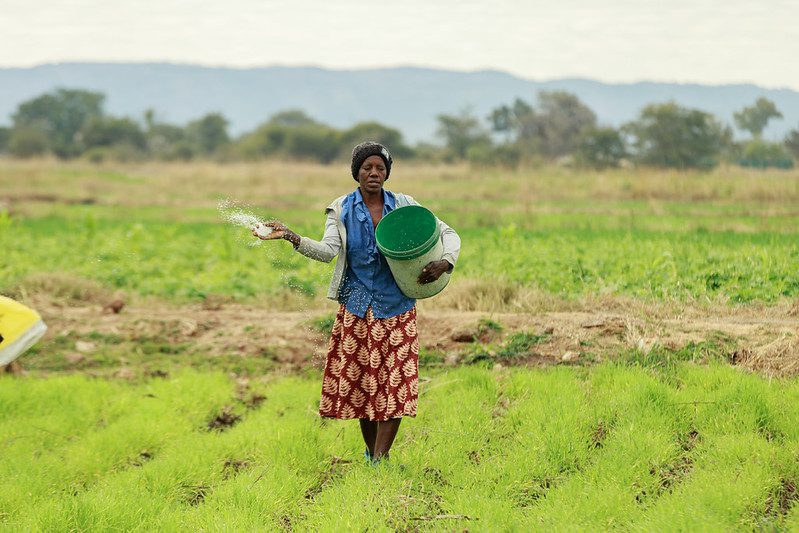
At the Mushandike Irrigation Scheme in Masvingo, farmers go to rest after a day’s work in the fields. The air hums with new promise – their farms were not this healthy and food-certain two years ago. So much has changed.
Yeukai has been farming in the Mushandike Irrigation Scheme since 1994, the year she married into village 16. While she has always enjoyed farming, she remembers years of struggling with low yields despite her best efforts.
She and her husband cultivated separate tracts of land, keeping some of their harvest for food while selling any surplus.
“Back then, I would farm but harvest very little. The main challenge was that we could not afford hybrid seeds and inputs like fertilizers were beyond our reach because they were expensive,” Yeukai recalls.
Life became even harder when she lost her husband and had to provide for their four sons on her own. Suddenly, it felt like farming was her life, but she could not do it alone.
 When the village elder encouraged farmers to form a group to support one another in accessing inputs such as hybrid seeds and organic fertiliser, which is expensive. Fourteen of them in the village came together and travelled to Harare to register a cooperative.
Through the cooperative, Yeukai and the other farmers connected with the Mushandike Agriculture and Rural Development Authority, which in turn introduced them to the Agricultural Finance Corporation.
Bit by bit, Yeukai began building her resilience. In addition to planting maize, she added the cultivation of wheat and sunflowers.
“Farming has changed for the better,” she reflects. “I have taken my children through O levels [a secondary school qualification]. My first son is a teacher in Buhera, another works in construction and his twin brother helps me at home and with the farm. My lastborn is in college and I have built my house. As for me, I am 52 but I still look like a teenager because I am healthy.”

One of her proudest achievements is investing in a grinding mill in 2024, now run by her son, so her neighbours no longer need to walk long distances to access flour.
Yeukai’s journey has also been strengthened by the Zimbabwe Emergency Food Production Facility (ZEFPF), a project launched in 2022 by the African Development Bank in partnership with FAO and the Government of Zimbabwe.
The Bank Group provided $25 million in funding: $20 million to be managed by FAO, and the remaining $5 million by the Africa Fertiliser Financing Mechanism (AFFM).
Through ZEFPF, Yeukai received improved inputs – fertilizers and certified seeds through the seed revolving fund, farming support and training on nutrition health – support that has helped her secure both her livelihood and her family’s future.
Alongside producing wheat, maize and sunflowers, Yeukai now rears free range chickens and ducks and is planning to add rabbits. She looks forward to fencing her homestead and starting a kitchen garden in her yard.
In Village 13, 40-year-old Taurai stands at the entrance of the homestead he built in 2024 – a dream made possible through the proceeds of his maize farm.
The father of four is married to Kunaka, an Early Childhood Development teacher. Taurai lost his sight at the age of 8 while in grade 2 and could no longer continue with school.

“My parents always took me to the farm. Even though I could not see, I understood what farming did for our family.”
Taurai recalls that farming was much harder when he was growing up: rains came only once a year, allowing for just a single planting season.
On some days, they had to ration their food so that they ate one meal a day. Today, with the irrigation canal, things are better.
Taurai cultivates a half hectare plot within the Mushandike Irrigation Scheme – 70 neat rows of maize given to him by his parents.
With the help of a friend and assistant he manages his farm with care and determination. “I pay a farm hand $35 for every weeding and planting cycle,” he says.

Before he was part of the ZEFPF project, Taurai harvested only about one ton from his half-hectare plot, largely due to lack of good seed and limited access to fertilizer.
Now, if his crops remain free of disease, his yields reach as high as three tons. And with the irrigation scheme, he is able to plant three times a year.
Taurai emphasises the need for more markets for farmers, who mostly sell their producer to the Grain Management Board (GMB).
“I hope to buy a truck, venture into horticulture, pig farming and chicken rearing to develop myself further as a farmer,” Taurai says.
Behind the progress in Mushandike are not only seeds and loans, but also people – like Julieth Ngwenyama, a dedicated extension officer.
She works closely with farmers, teaching them about ecological farming practices, the importance of organic inputs and how to monitor soil moisture to get the best out of their land.
“Wheat yields rose from 2 metric tons per hectare (MT/Ha) to 5 metric tons per hectare, while maize yields jumped from 0.76 MT/Ha to 3.1/Ha. These gains contributed to the creation of nearly 170,000 jobs across cropping seasons, fuelling local economies and restoring household food security,” notes Zwelo Ndebele, Projects Coordinator at FAO Zimbabwe, in reference to the milestones achieved by the ZEFPF project.
It will soon be morning, and the fields will call again. But for now, Yeukai, Taurai and other smallholder farmers in Mushandike pause in quiet appreciation of their changing reality.
It is not just their land that looks different—their lives do too. With every season, they are planting more than crops; they are planting security, dignity, hope and harvesting change.
Discover more from CLIMATE BRIEF
Subscribe to get the latest posts sent to your email.